Understanding the difference between “as fed” and “dry matter” helps explain why pasture, hay and haylage can’t be compared by weight alone. It’s also the reason nutritionists evaluate feeds on a dry matter basis when assessing whether a horse’s diet is meeting its nutrient requirements.
“As fed” simply means the feed exactly as your horse eats it, including both its nutrients and its water content.
If you weigh:
each weighs 1 kg as fed.
However, although they weigh the same, they do not provide the same amount of nutrition because they contain very different amounts of water.
Dry matter is the portion of a feed that remains after all of the water has been removed.
It contains the nutrients your horse relies on, including:
Water is essential for hydration and many normal body functions, but it doesn’t contribute energy, protein, vitamins or minerals. Removing the water from the calculation allows feeds with different moisture contents to be compared fairly.
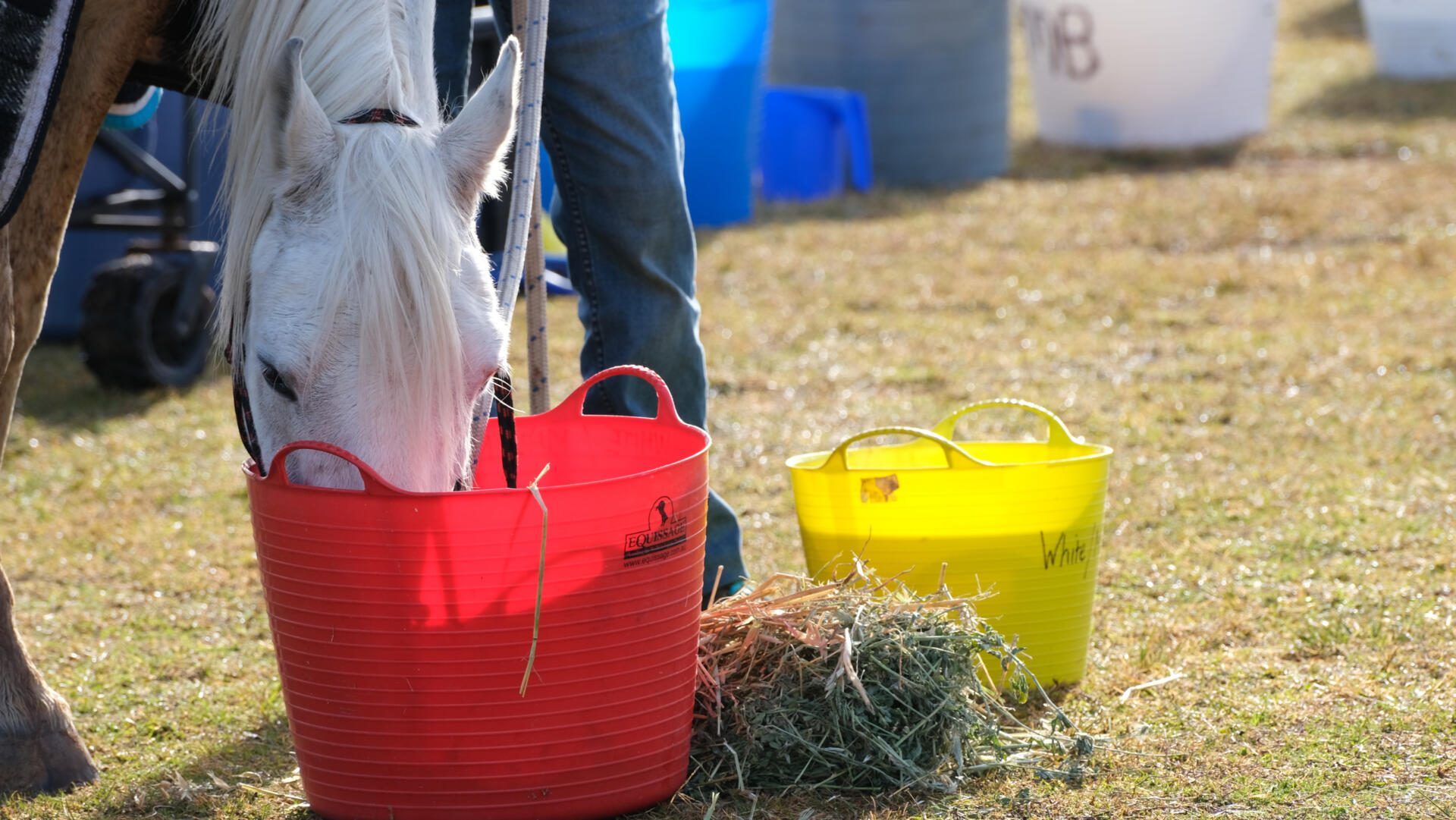
Imagine comparing two buckets.
One is filled mostly with hay. The other is filled mostly with water.
Even if the buckets weigh exactly the same, they clearly don’t contain the same amount of nutrition.
The same principle applies to horse feeds. Water adds weight but very little nutrition. By comparing feeds on a dry matter basis, nutritionists can accurately compare pasture, hay, haylage and concentrates, regardless of how much moisture they contain.
The amount of water in forage varies considerably. This means two feeds that weigh exactly the same can provide very different amounts of nutrition.
| Feed | Typical Water Content | Typical Dry Matter |
|---|---|---|
| Fresh pasture | 75 to 85% | 15 to 25% |
| Haylage | 35 to 50% | 50 to 65% |
| Hay | 10 to 15% | 85 to 90% |
| Pelleted feed | 8 to 12% | 88 to 92% |
You’ll notice that forage analyses are almost always reported on a dry matter basis. This allows hays, haylage and pasture samples to be compared fairly, regardless of how much moisture they contain.
Imagine your horse eats 10 kg of fresh pasture that contains 20% dry matter.
That provides:
Now compare that with 10 kg of hay containing 90% dry matter.
That provides:
Although both meals weigh 10kg, the hay provides more than four times as much dry matter.
This doesn’t mean hay is “better” than pasture. It simply demonstrates why feeds with different moisture contents can’t be compared just by “as fed” weight.
Understanding dry matter helps answer many of the practical questions horse owners face every day, including:
Without considering moisture content, it’s easy to overestimate how much dry matter — and therefore nutrients — a horse is receiving, particularly when grazing lush pasture or feeding high-moisture forages.
You’ll often see recommendations that horses should consume at least 1.5% of their body weight as forage each day.
This recommendation refers to forage dry matter intake, not the fresh weight of the forage.
For example, a 500 kg horse should consume at least 7.5 kg of forage dry matter each day.
That could be approximately:
The amount of forage required changes because the moisture content changes.
Many horses consume around 2% of their body weight as forage dry matter each day, depending on age, workload, body condition and the overall diet.
FeedXL automatically accounts for the moisture content of feeds before calculating nutrient intake.
This means pasture, hay, haylage and other feeds are compared based on the nutrients they actually provide, rather than simply on how much they weigh.
FeedXL evaluates diets on a dry matter basis rather than simply comparing feeds by weight. This allows nutrient intake to be assessed more accurately and helps identify whether any adjustments may be needed.
“As fed” tells you how much feed your horse is eating.
“Dry matter” standardises nutrient levels so you can compare them. It also allows you to calculate forage or total intake and ensure you’re meeting your horse’s requirements.
Understanding the difference removes one of the biggest sources of confusion in horse nutrition.
It’s a simple concept, but one that underpins almost every accurate nutrition calculation. Once you understand dry matter, you’ll have a much clearer picture of what your horse is really eating, and can build a more balanced diet.
FeedXL members — now’s the perfect time to see how dry matter plays out in your own horse’s diet.
Log in and review your forage and fibre balance »
Not using FeedXL yet?
Join today to start building scientifically balanced diets for your horse »
While many of us struggle to keep weight off our horses (and ourselves!) it seems a large number of horse owners have equal trouble when it comes to putting weight on their horses. Putting weight on and keeping weight on a horse that is a “hard keeper” can sometimes be a frustrating task for the horse’s owner. But it needn’t be a difficult thing to do. This article will walk you through the most important things to consider, including the best horse feed for weight gain.
Here are 7 simple steps you should take on the journey to putting weight on your horse:
Make sure your horse is wormed with an effective wormer. If you are not sure which wormer to use, ask your veterinarian and make sure that you are worming for Bots as well as Tapeworms at the appropriate times of year.
Have a qualified dentist correct any issues with your horse’s teeth. If it is painful or difficult for your horse to chew, he/she just physically won’t be able to consume the amount of feed needed to gain weight.
Ask your veterinarian to carry out a full health check to make sure there is no underlying disease like gastric ulcers (which will be common in off the track or spelling thoroughbreds) that are going to prevent the horse from eating and gaining weight. If you do discover your horse has a problem with ulcers have them treated with appropriate medications. Likewise, if any other disease conditions are found work with your veterinarian to resolve them.
Please note that if your horse is emaciated and has come from a starvation situation, you should follow the guidelines published by the American Association of Equine Practitioners for caring for starved/emaciated horses. Introducing feeds too quickly into the diets of these horses can result in ‘refeeding syndrome’ and death. The guidelines can be found here: AAEP Rescue and Retirement Guidelines – AAEP
Weight gain occurs when the amount of calories provided in the horse’s diet exceeds the amount of calories the horse ‘needs’ on a daily basis – the excess calories are stored by the horse and thus contribute to weight gain. Many horses have problems gaining weight simply because they aren’t being fed enough to gain weight.
After addressing worms, teeth and health, the most important feeding step when you want a horse to gain weight is to provide as much pasture or grass/meadow hay as the horse can eat. You can do this by either giving your horse 24-hour access to pasture or by feeding just enough hay that a little is left over each day. If you can devise a way to feed the hay at ground level without the horse walking all over it will mean the left-over hay isn’t wasted. If you can’t find grass/meadow hay, oaten hay is a suitable substitute.
Feed lucerne hay. Lucerne (known as alfalfa in North America) is a high energy forage and makes a valuable contribution to raising a horse’s calorie intake above their daily requirement to encourage weight gain. Lucerne will also provide your horse with good quality protein which will facilitate muscle development. This is particularly important if your horse suffered muscle wastage at the time that weight loss occurred.
It is difficult to make a recommendation as to exactly how much lucerne should be fed as each horse’s requirement will vary depending on the degree of weight gain required, their temperament (as occasionally lucerne hay will cause behavioural changes in some horses) and the quality of grass/meadow hay being fed. Between 0.5 kg and 1 kg of lucerne hay per 100 kg body weight per day is a good place to start.
Add high energy feedstuffs to your horse’s diet. If the desired rate of weight gain is not achieved after implementing the steps above, your horse still requires additional calories over and above that provided by the pasture and hay being fed. To increase your horse’s calorie intake even further you now have three high energy feed options to consider adding to your horse’s diet. These are:
The ‘correct’ balance of these feeds is going to depend on your individual horse. (Hint: that’s where FeedXL comes in!)
Make sure the diet is balanced—if your horse’s diet is unbalanced from a protein, vitamin and mineral perspective it is likely that this will prevent your horse from gaining weight, regardless of how much you are feeding it. Using the FeedXL nutrition software will make sure your horse’s diet is balanced and that there are no deficiencies which may be preventing weight gain. If you’re not already a member, click here to learn more about our plans and get started for free today.

Unfortunately, when we start feeding our horses a well-balanced diet with calories in excess of their requirements, they tend to try and find gainful employment for all their newfound energy which often results in unruly, undisciplined and at times dangerous behaviour when we ride them.
The question then is, how do you feed your horse for weight gain without having them trying to kill you when you ride them? The answer to this million dollar question is … you can’t, unless your horse is well disciplined to begin with. If you own a horse that you can only just control when it is not being fed for weight gain, then you should not expect that you will be able to feed it gross amounts of feed to encourage weight gain AND still ride it safely, because it is just not going to happen. The golden rule is education first, feeding for weight gain second. The exception to this rule is when you have an emaciated horse that needs to be fed to gain weight before you can begin riding it.
You may still find that a well-educated horse becomes a little more difficult to handle when being fed a high energy weight gain diet. In this case, altering the types of feeds you are using may help. The high energy fibrous feeds and high fat feeds and oils tend to have the ability to promote weight gain without having as much effect on their behaviour. But this isn’t always the case, so you still need to be careful.
You should not expect that your horse will instantly begin to gain weight once you have placed him on a ‘weight gain diet’. Some horses and particularly those who have come from an emaciated state will have internal damage caused by weight loss that they must repair before visible weight gain will occur. Even if this is not the case visible weight gain may take weeks to appear. In short, make sure your horse is healthy, develop and feed a well-balanced diet using your preferred ingredients, don’t skimp on feeding hay and be patient.
Join FeedXL today and take control of your horse’s nutrition
Get EVEN MORE practical and personalised feeding guidance when you sign up to FEEDXL.
SIGNUP TO FEEDXL NOW
We would love to welcome you to our FeedXL Horse Nutrition Facebook Group. Ask questions and have them answered by PhD and Masters qualified equine nutritionists and spend time with like-minded horse owners. It’s free!
Click here to join the FeedXL Horse Nutrition Facebook Group